4.14.2007

Targeting the Community

So I went down to the National Gallery of Modern Art to check out the Jasper Johns exhibit today.

The National Gallery of Art describes it as the following:
Jasper Johns: An Allegory of Painting, 1955-1965 presents some of Johns' most iconic paintings, drawings, and prints selected from public and private collections, including the artist's own. Departing from the format of the survey or retrospective, the show will trace the unfolding relationship of four specific motifs in Johns' works-the target, the "device," the stenciled naming of colors, and the imprint of the body-revealing the works' significance to the following generation of artists. The exhibition includes the largest group of target paintings ever assembled. After Washington, the exhibition will travel to the Kunstmuseum Basel, June 2 through September 9, 2007, the only other venue. The exhibition is organized by the National Gallery of Art, Washington.

One of the motif's the exhibition focuses on is "the target."


Who sponsors this exhibition? Target.


The National Gallery website goes on to say:
Jasper Johns is one of the most influential figures in the history of postwar art and the National Gallery of Art's commitment to his work draws from its profound historical significance," said Earl A. Powell III, director, National Gallery of Art. "We are proud to premiere an exhibition of this scope, which provides enormous insight into Johns' philosophy of painting. We are enormously grateful to Target for this sponsorship- its fourth sponsorship at the National Gallery of Art- and Target's continuing commitment to the Gallery.

An article statement by Target.com says:
Target believes in the power of partnerships with leading cultural institutions to foster creativity, promote learning and build stronger communities. Target is therefore proud to continue its partnership with the National Gallery of Art in Washington as the sponsor of Jasper Johns: An Allegory of Painting, 1955 – 1965. Through this exhibition, guests will experience Johns’ early period of work and view some 80 exceptional works that have had an immense impact on the development of advanced art.

Now, I'm no art expert, but what is fascinating to me is that Johns' work deals with seeing the same image over and over again. He made lots and lots of targets and made pieces about making targets etc. So here's Target paying for an art exhibit about the target icon. I'm not sure which philosophical term applies to that, but I'm sure something's going on there.

2.21.2007

Romney Supports a State's Right to Choose

Listening to George Stephanopoulos' interview with Mitt Romney on ABC's This Week, I was struck by the Governor's explanation of his stance on abortion. While he was once pro-choice and now describes himself as pro-life, what he really likes to focus on is the states' right to determine whether they are pro-life or pro-choice. He said that under his policy, Massachusetts would remain a pro-choice state.

"My view is that we should let each state have its own responsibility for guiding its laws relating to abortion.

My preference would be to see the Supreme Court do something which is up to them, not up to me. Even if elected president, I don't guide this. The Supreme Court does.

But I'd like to see the Supreme Court allow states to have greater leeway in defining their own laws."

Describing his position as an assertion of states' rights seems to be an appeal to the conservative base, but the key element of his policy can be summed up in one word: choice. Weird how someone who is trying to position themselves as pro-life is actually emphasizing their belief in choice. In fact, when I heard him describe his position I thought, if I didn't know any better I would think he's arguing for a pro-choice policy.
"I feel a great empathy for women who have difficult decisions in this regard. I don't want to impose my view on the lives of women, and yet this is one of those points where mature men and women have to come together and say, "What's the right course?" And in my particular view, I believe in life, I believe in respecting life, and I believe that we should, as a series of states, allow states to make their own choice in this regard."
If it's okay to devolve the decision on abortion from the federal government to the states, why not let each county decide? And if it's okay for each county to develop their own policy, why not let each municipality decide if they are a pro-choice or pro-life community? Wait...if it's okay for each community to decide why not let each household decide?

It seems to me that in supporting a state's right to choose, Romney has revealed his pro-choice beliefs. I'm not upset with him for this, I just wish he wouldn't try to paint his beliefs in conservative clothing.

Heaven only knows

So The Economist lays out what a possible merger of the Catholic and Anglican churches would look like. It's one of those stories that you read and think--is this an April Fool's joke?

I think it goes to show how religion is understood and discussed in the British press versus the U.S. It is hard to imagine a U.S. newspaper carrying out the same line of reasoning.

2.07.2007

A DRM Tipping Point?

Steve Jobs' essay "Thoughts on Music," posted on the Apple.com website yesterday has unleashed a fury of discussion on the future of digital rights management or DRM.

Steve Jobs writes, “With the stunning global success of Apple’s iPod music player and iTunes online music store, some have called for Apple to ‘open’ the digital rights management (DRM) system that Apple uses to protect its music against theft, so that music purchased from iTunes can be played on digital devices purchased from other companies, and protected music purchased from other online music stores can play on iPods. Let’s examine the current situation and how we got here, then look at three possible alternatives for the future.”

This rather low key essay resulted in a front page story on today's Financial Times, was discussed on the Economist website, and was the lead story on PRI's Marketplace morning report--among other places.

Not only is the topic of discussion important and potentially transformative, the mode with which this discussion has developed is itself intriguing. Jobs, famous for his theatrical presentations, posted his thoughts on a webpage with little fanfare. This meme was then picked up by numerous sources in the "traditional media." It will be interesting to watch this story develop and see if it has any affect on the use of DRM technology in the music industry.

Stay (i)tuned.

2.06.2007

Close but no cigar

According to the Economist, we residents of Washington, D.C. are almost full fledged participants in this experiment we like to call democracy:

"DC's congressional representative—and those of Puerto Rico, Guam, American Samoa and the Virgin Islands—inched closer to gaining full voting rights in late January. The House passed a bill allowing the five territories to vote, although if any of their votes prove decisive, the ballot will be cancelled and retaken without them. Eleanor Holmes Norton, DC's long-time congresswoman, had sponsored a bill to award these representatives full rights. So she was disappointed with the compromise, which restores the rights the representatives had before the Republican congressional takeover in 1994. She has described it as 'heartbreaking'."

Wow, thanks guys. Our elected representative is allowed to vote, but if her vote proves decisive the ballot is cancelled?! Doesn't that really defeat the voting in the first place? It reminds me of when I was a senior in high school and it came time to vote for a class song. Pink Floyd's "Another Brink in the Wall Part II" won decisively. Well this song, with it's famous line "we don't need no education," proved too much for the school administration to handle. What was their solution? The vote was retaken, but this time we were only allowed to vote for one of three pre-approved songs. Wow! How exciting! I could hardly bear the suspense! At least in this case, we were voting on a rather meaningless issue like a class song, not on huge issues like the war in Iraq and what to do about the millions of Americans who don't have health care. (In the end, John Cougar Mellancamp's "Small Town" won, and I have never quite recovered--as is obvious from this post.)

I would almost prefer the District (and other territories) weren't thrown such a pathetic bone by those members of congress (predominantly Republican) who'd prefer to get the issue off the agenda. Now they can pretend like they addressed the issue, when all they really did was come up with a politically opportunistic way to act like they did.

Let's hope our newly elected Democratic Congress will address the hypocracy of working so hard to bring democracy to far flung regions of the world while the citizens who live in our nation's capital enjoy no such right.

1.20.2007

New Politics website launches Jan 23

From the Politico Website:

OUR GOAL

The Politico is being launched in January 2007 with the mission of covering politics -- the lifeblood of the nation’s capital -- with enterprise, style, and impact.

We will bring an unblinking focus to three arenas of coverage: the politics of Capitol Hill and of the presidential campaign, and the business of Washington lobbying and advocacy.

This ambitious goal will be matched with the resources to achieve it. The Politico will assemble the most interesting and revelatory journalists—a mix of established names and promising young reporters—and set them to work on bringing to life the most important stories.

As a new venture, we will embrace the way journalism is changing. Our stories will be conversational and engaging, and illuminate the agendas and personalities behind the news. We will always look for the most creative way to tell stories—on the printed page, on the Web, and on television. But this spirit of innovation will be harnessed to old and enduring values—a belief in rigorous reporting, fair presentation, respect for our audience.

Henry James called Washington “the city of conversation.” The Politico’s place is to cover that conversation, and to set it.

1.15.2007

The Countdown to 1000 hits

We are now a mere 10 hits away from the big millennium mark.

Truly cause for celebration.

The only question remains...where will lucky #1000 be from?

Nose to the Grindstone

My posting on this blog goes in waves. I have periods of time when I'm on here frequently and then I'll go for a month or two without saying much. I'm going to try to post on a more regular basis. (This a rather lame attempt to get the ball rolling). Maybe my lack of activity has something to do with the Nov-Dec holiday season, but there are lots of interesting things going on that I plan on writing about.

Happy New Year.

12.15.2006

what can you find with google patent search?

check out this blog post on wired:

"Google's powerful patent search engine allows immediate access to the documents that have driven innovation for more than a century.


Pictured is Wilbur and Orville Wright's airplane, but other famous inventors are well-represented: Nikola Tesla and Thomas Edison intrigue.

Looking for Sir Clive Sinclair's cool but commercially ruinous C5 electrical vehicle, my Google-fu failed me, though I did chance across his more successful foldable bicycle. In today's business era, it's all about companies. Apple Computer offers some interesting results, but IBM is boring: one could count dynamoelectric nonmagnetic laminates as a cure for sleeplessness.


Let's cut to the chase. Flying machines of every description take off, but perpetual motion machines stay grounded. Patent officials throw crazy patent claims in the trash nowadays, but try zero-point energy to get modern krankery, that being a code phrase which is to the old perpetuum mobile as Intelligent Design is to Creationism. World War II computers rule -- as do their earlier counterparts.


Makeblog found the original patents for the Transformers. Alas, no Gobots.

Of course, there is the inevitable focus on genitalia, male and female, ranging from sex toys to cleansing devices that no sane person would allow near their vitals. Don't miss the opportunities for improvement.


Last (and first), come innovations prior to 1850: magical, mystical devices ranging from terrifying coathangers to devices used to mercilessly torture vegetables.

So, what have you found?"

11.24.2006

the emerald city?

According to the Washington Post, the D.C. city council is considering a measure that would require all new city construction to comply with "green" building standards:

"...within two years all new District-owned projects, including schools, would have to meet the green standards, and in 2009, any building receiving more than 20 percent public financing would have to do the same. By 2012, every new commercial building over 50,000 square feet -- about the size of a medium-size retail store -- would have to meet the guidelines. The rules would also apply to affordable housing."

Very cool.

10.26.2006

Room to Read

From the Room to Read website:

"Room to Read partners with local communities throughout the developing world to establish schools, libraries, and other educational infrastructure. We seek to intervene early in the lives of children in the belief that education is a lifelong gift that empowers people to ultimately improve socioeconomic conditions for their families, communities, countries, and future generations. Through the opportunities that only an education can provide, we strive to break the cycle of poverty, one child at a time.
Results to Date

Since our inception in 2000, Room to Read has impacted the lives of over 1,134,000 children by:

* Constructing 221 schools
* Establishing over 3,374 libraries
* Publishing 99 new local language children's titles representing over 930,000 books
* Donating over 1.2 million English language children's books
* Funding 2,344 long-terms girls' scholarships
* Establishing 108 computer and language labs

Vision for the Future

Room to Read's vision is bold - to help 10 million children in the developing world gain the lifelong gift of education. Through our work, we will reach tens of thousands of communities in the developing world through Room to Read schools, scholarships, and libraries, and whole generations will have more opportunity and greater access to education than their parents. Through our work, many more children in the developing world will grow up to have jobs and be able to invest in the future of their own country. Through our work, Room to Read will be among the leaders in building, measuring, and evaluating education programs around the world. Our donors will be continually inspired because they be able to see a direct link between their investment and positive changes in the lives of children.

Strategic planning is core to the ongoing success and sustainability of Room to Read. In 2005 and 2006, the Management Team, Staff and Board of Directors of Room to Read worked diligently to create a plan that will direct our initiatives and energies for the next five years. Adopted in July 2006, the Strategic Plan provides a blueprint for a better world - a world in which millions of children throughout Asia, Africa and Latin America gain access to schools, libraries, books, teachers and computers; a world that is forever changed by the empowerment and self-sufficiency that only education can provide.

Our goals include:
Geographic Expansion

There are more than 770 million illiterate adults in the world - two-thirds of whom are women and girls. In addition, there are over 100 million children not currently enrolled in primary school and millions of others not currently in secondary school. The need for Room to Read's educational programs spans the globe. To respond to this worldwide demand for our programs, Room to Read is committed to expanding geographically. Our expansion plans include:

* Africa - In 2006, Room to Read is launching onto the continent of Africa by opening operations in South Africa. Our goal is to be in at least four countries in Africa by 2010.
* Latin America - Recognizing the need for educational infrastructure throughout the developing world, we plan to launch into Latin America in 2008. Although no countries have been selected yet, our goal is to be in a total of three Latin American countries by 2010.
* Continued Expansion within Asia - As we expand into Africa and Latin America, we will also maintain our commitment to expanding our reach within the countries we are currently operating in Asia. Additionally we will launch into two new countries in Asia by 2010.

Ensuring the Quality of Our Programs

Room to Read is dedicated to transparency, performance and innovation. As we expand into new geographies, it is critical that we ensure our programs are of the highest quality and are run effectively and efficiently. To this end, we will continue to develop and invest in systems to monitor and evaluate our work, while at the same time implement our programs in a flexible manner to best fit the local context. By using international tools that provide a standard monitoring system across the organization and hiring external evaluators to judge our results, Room to Read will continue to invest in the critical components needed to deliver excellent educational programs.

Building Our Capacity

A strong organizational foundation is critical to sustaining Room to Read's growth and impact. We are committed to creating well-codified business processes, ensuring we have the proper management structure and global staff in place to create world-class communications and technology infrastructure. In this way, we will be able to continue to offer quality programs to more children, in more countries, over many generations.

We hope you will join us in this bold new vision for the future of Room to Read!"

10.14.2006

Simple software to help you get organized

37signals has created a new set of software designed to enhance your productivity while simplifying your life. Pretty cool.


“Basecamp and Backpack were awarded Best of the Web 2005 awards by the editors of BusinessWeek.”
-BusinessWeek

“37signals is the best little web company of 2005 (Yahoo was the best big web company of 2005)”
-Richard MacManus, Best Web Companies and Innovators of 2005

“37signals’ Basecamp and Backpack are the future of software on the web.”
-Farhad Manjoo, Salon.com Cover Story

“The best example [of online organizer tools] is a service called Backpack (which has been drawing attention among bloggers who focus on productivity tips).”
-Thomas Weber, Wall Street Journal story

10.11.2006

Muammar el-Qaddafi buys into $100 laptops

The New York Times reports:

"The government of Libya reached an agreement on Tuesday with One Laptop Per Child, a nonprofit United States group developing an inexpensive, educational laptop computer, with the goal of supplying machines to all 1.2 million Libyan schoolchildren by June 2008."

I've been a fan of Nicholas Negroponte's since I started reading his column in Wired Magazine in the mid-1990s. Negroponte is the founder of the One Laptop Per Child Initiative. What I didn't realize is that United States Intelligence Director, John D. Negroponte, is his brother!

Maybe the Intelligence Director should solicit some of the advice of Nicholas' colleagues at the MIT Media Lab on how to streamline the cumbersome U.S. intelligence computer systems.

[Photo copyright Thomas A. Bass 1995]

10.07.2006

the inner life of the cell


via information aesthetics

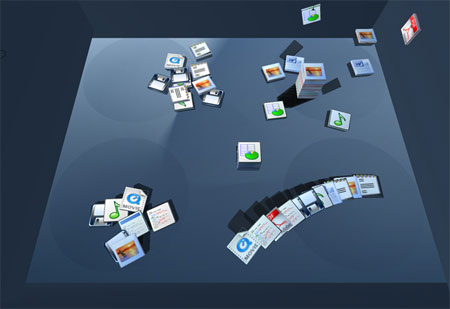
BumpTop ProtoType


"BumpTop aims to enrich the desktop metaphor with expressive, lightweight techniques found in the real world."

Strange Clouds


check them out

and The Cloud Appreciation Society

UNESCO and the Millennium Development Goals

"World leaders gathered at the Millennium summit agreed on these goals in 2000, and they were reaffirmed last year. They represent a major challenge for the nations of the world, and UNESCO is doing its part to help assure that they are met."

UNESCO In the Spotlight: Education and Culture


Check out the UNESCO website on its support for the MDGs.

9.27.2006

Reading Between the Lines

I have been addicted to magazines since I was about twelve. I remember getting Consumer Reports for Kids and then they went bankrupt and I didn't understand how they could just stop sending me their magazine when I had already paid for it. Consumer Reports for Kids, boy that sounds exciting.

I've been a Wired reader for 12 years now. It's fascinating to go back and read issues from the mid-90s. You can also gauge the state of the "new economy" based on how thick the magazine is. In addition to Wired, I read the Economist, Shambala Sun, The Atlantic Monthly, Fast Company, Men's Health, Alternative Medicine, and many others.

There's just something about magazines that captivates me. I like that they're not outdated instantly like a newspaper, yet more easily digestable than a book.

There's also something to the cultural artifact that is the magazine rack. We all know that we could pay soooo much less if we'd just subscribe. Magazine publishers want to guarantee their advertisers a certian number of eyeballs and are willing to save us some cash if we will commit ahead of time, yet part of the fun of magazines is not just reading it, but the practice of selecting a particular magazine among a plethora of options. You walk into your local bookstore and pick out the issue that fits you.

Then again, there's the predictable comfort of knowing your magazine will arrive on a certain day. Your Sports Illustrated in the mailbox on Thursday or your Economist on the front steps on Friday--unless you live in my neighborhood where it's been known to appear anywhere from Friday to Monday. Ahh, the anticipation!

Jack Shafer writes about his relationship with magazines on Slate's site.

What magazines do you love?